

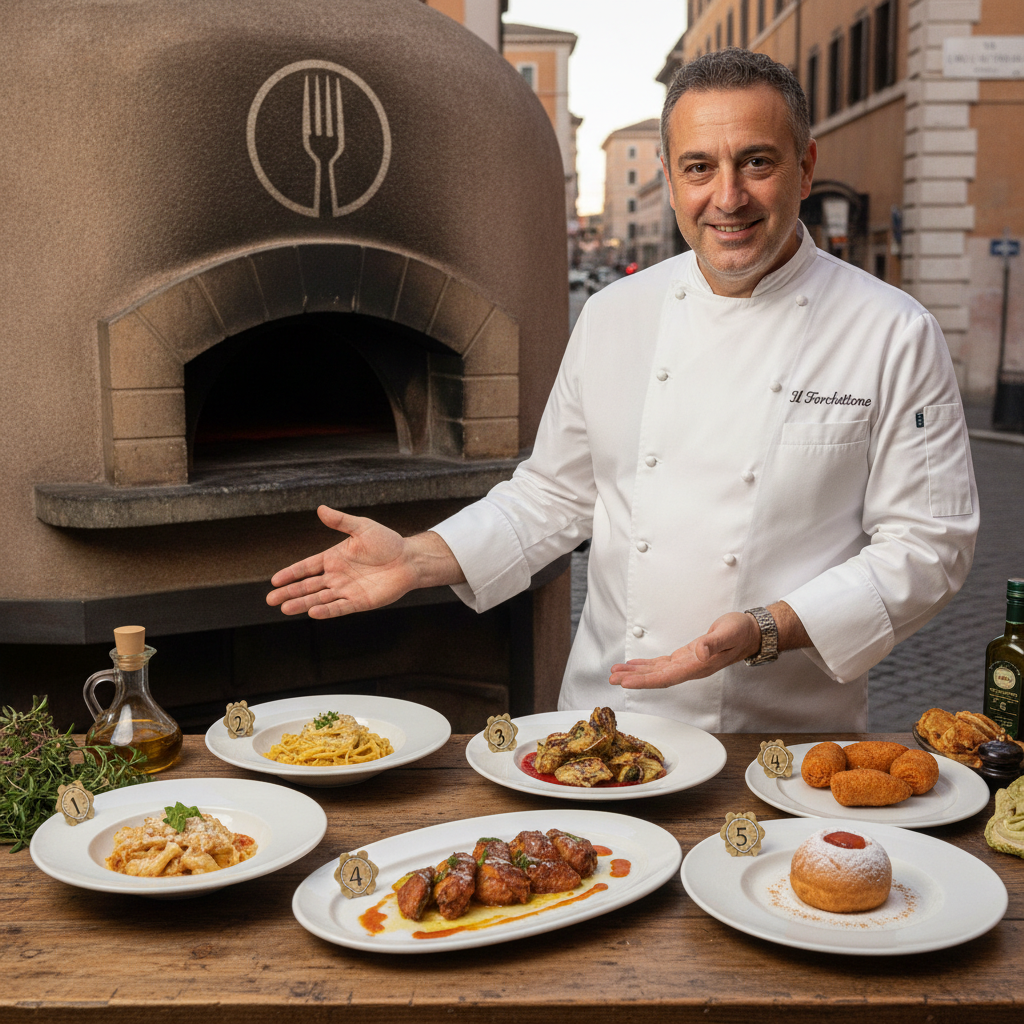
Welcome to the heart of Rome, where history is not only found in the ruins of the Colosseum but also on the plates served in our vibrant neighborhoods. At Il Forchettone, located at Via Val Trompia 8/10, we believe that understanding the soul of Roman cuisine requires looking beyond the surface. Whether you are a local or a traveler seeking an authentic experience, we invite you to discover the 5 best secrets of Lazio's gastronomy explained by experts.
1. The Sacred Alchemy of Pecorino Romano and Guanciale
The foundation of Roman pasta—be it Carbonara, Amatriciana, or Gricia—relies on a specific chemical harmony between fat and salt. While many international adaptations use bacon or Parmesan, the true secret of Lazio’s gastronomy lies in the marriage of Guanciale (cured pork jowl) and Pecorino Romano DOP. Guanciale provides a silky, peppery fat that melts at a low temperature, creating a natural emulsion.
Experts agree that the sharp, salty punch of Pecorino Romano is essential because it cuts through the richness of the pork fat. At Il Forchettone, we source our ingredients from local producers who respect the traditional curing processes. To learn more about the strict standards of Italian culinary heritage, you can visit the official site of Gambero Rosso, the leading authority on Italian food and wine. The secret isn't just the ingredient itself, but the ratio and the temperature at which they are combined to create that famous Roman creaminess without ever using heavy cream.
2. The Roman Fusion Revolution: Respecting Roots while Breaking Rules
Lazio's gastronomy is often seen as static, but experts will tell you that Roman food has always been about evolution. At Il Forchettone, we specialize in Roman Fusion, a culinary philosophy that takes traditional flavor profiles and integrates them with broader Mediterranean techniques. This is one of the "secrets" that modern food critics are beginning to highlight: the adaptability of the Roman palate.
For example, taking the classic "Coda alla Vaccinara" (oxtail stew) and reimagining it as a filling for delicate ravioli or pairing it with spices from the southern Mediterranean creates a bridge between the past and the future. Fusion isn't about erasing tradition; it's about using the robust flavors of Rome—like mint, pecorino, and artichokes—in ways that surprise and delight the modern diner. This approach allows us to maintain the "Romanity" of the dish while offering something entirely unique to our guests on Via Val Trompia.
3. The Secret of the "Quinto Quarto" (The Fifth Quarter)
One cannot discuss the 5 best secrets of Lazio's gastronomy explained by experts without mentioning the Quinto Quarto. Historically, the wealthy Roman elite consumed the prime cuts of meat, leaving the "fifth quarter"—the offal—for the working class and the slaughterhouse workers (the Vaccinari).
The secret here is the incredible culinary ingenuity required to turn humble ingredients like tripe, heart, liver, and sweetbreads into gourmet delicacies. Dishes like Trippa alla Romana, simmered with tomato, mint, and plenty of Pecorino, demonstrate a mastery of slow-cooking and seasoning. Experts point out that the depth of flavor found in these dishes is unmatched by more expensive cuts. It represents the resilience and creativity of the Roman people, turning necessity into a world-class gastronomic tradition.
4. The Art of the Roman Fry: From Jewish Ghetto to Global Fame
Deep-frying is a cornerstone of Lazio’s culinary identity, but there is a precise science behind it. The secret to the perfect Roman fry—whether it’s a Supplì (rice ball) or the iconic Carciofo alla Giudia (Jewish-style artichoke)—is the temperature and the type of oil used. Experts emphasize that a true Roman fry must be "asciutto" (dry) and incredibly crisp.
The Carciofo alla Giudia is perhaps the best example of this secret. It requires a double-frying technique: first at a lower temperature to soften the heart of the artichoke, and then a second "flash fry" at a high temperature to make the leaves bloom like a flower and turn them into golden, salty "chips." At Il Forchettone, we honor this tradition by ensuring our fried specialties are prepared to order, capturing that perfect crunch that has defined Roman street food and Jewish-Roman cuisine for centuries.
5. The Influence of the "Agro Romano" and Seasonality
The final secret of Lazio's gastronomy is the land itself. The "Agro Romano," the rural area surrounding the city, provides a volcanic soil rich in minerals that gives local vegetables a unique flavor profile. Experts suggest that you haven't truly tasted Roman food until you've tried vegetables harvested at their peak in this region.
From the bitter bite of Puntarelle (chicory sprouts) served with an anchovy and garlic dressing to the sweetness of the Romanesco broccoli, the secret lies in the short distance from farm to table. At Il Forchettone, we curate our menu based on the Roman seasons. We believe that the Mediterranean diet is not just a list of ingredients, but a rhythm of life. By using seasonal produce from the Lazio countryside, we ensure that every dish reflects the authentic "terroir" of our region.
Visit Il Forchettone at Via Val Trompia 8/10
Now that you have uncovered the 5 best secrets of Lazio's gastronomy explained by experts, it is time to experience them for yourself. At Il Forchettone, we combine the warmth of traditional Roman hospitality with a sophisticated touch of Mediterranean fusion. Our kitchen is a place where secrets are shared through every bite, and every guest is treated like part of the family.
Located at Via Val Trompia 8/10, 00141 Rome, our restaurant is the perfect destination for those who want to explore the true essence of Roman flavors in a contemporary and welcoming setting. Whether you are craving a perfectly executed classic or a bold new fusion creation, we look forward to welcoming you and sharing the magic of Lazio's culinary heritage. Come and taste the history, the passion, and the secrets of Rome at Il Forchettone.